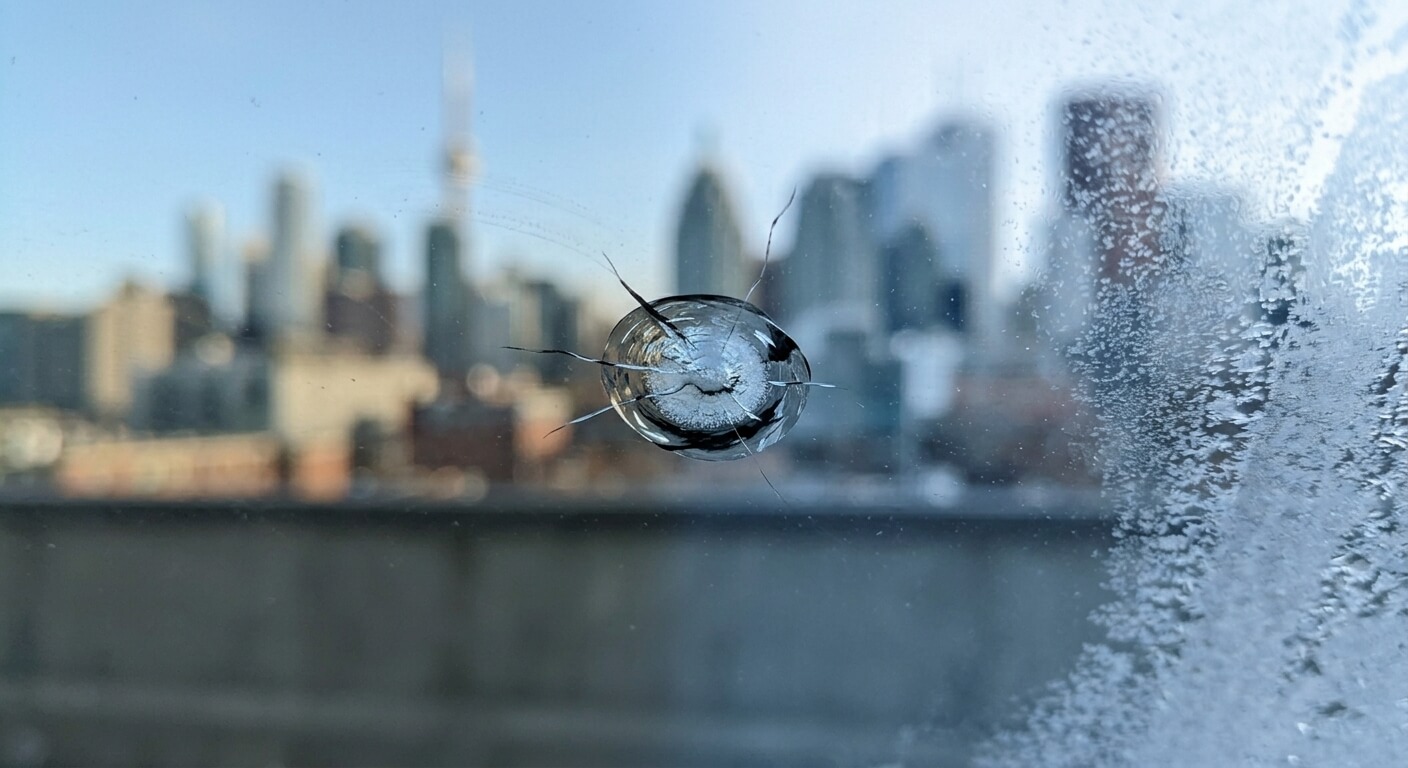
A truck ahead of you on the 401 kicks up a small stone. It hits your windshield with a sharp crack sound, and now there’s a small mark on the glass. This is the single most common way Toronto drivers damage their windshields and whether that stone chip turns into a quick, free repair or a costly replacement comes down to exactly two variables: how big the chip is, and how fast you act. This guide explains the physics behind both, so you understand not just what to do, but why it matters.
1. Can a stone chip in a windshield be repaired?
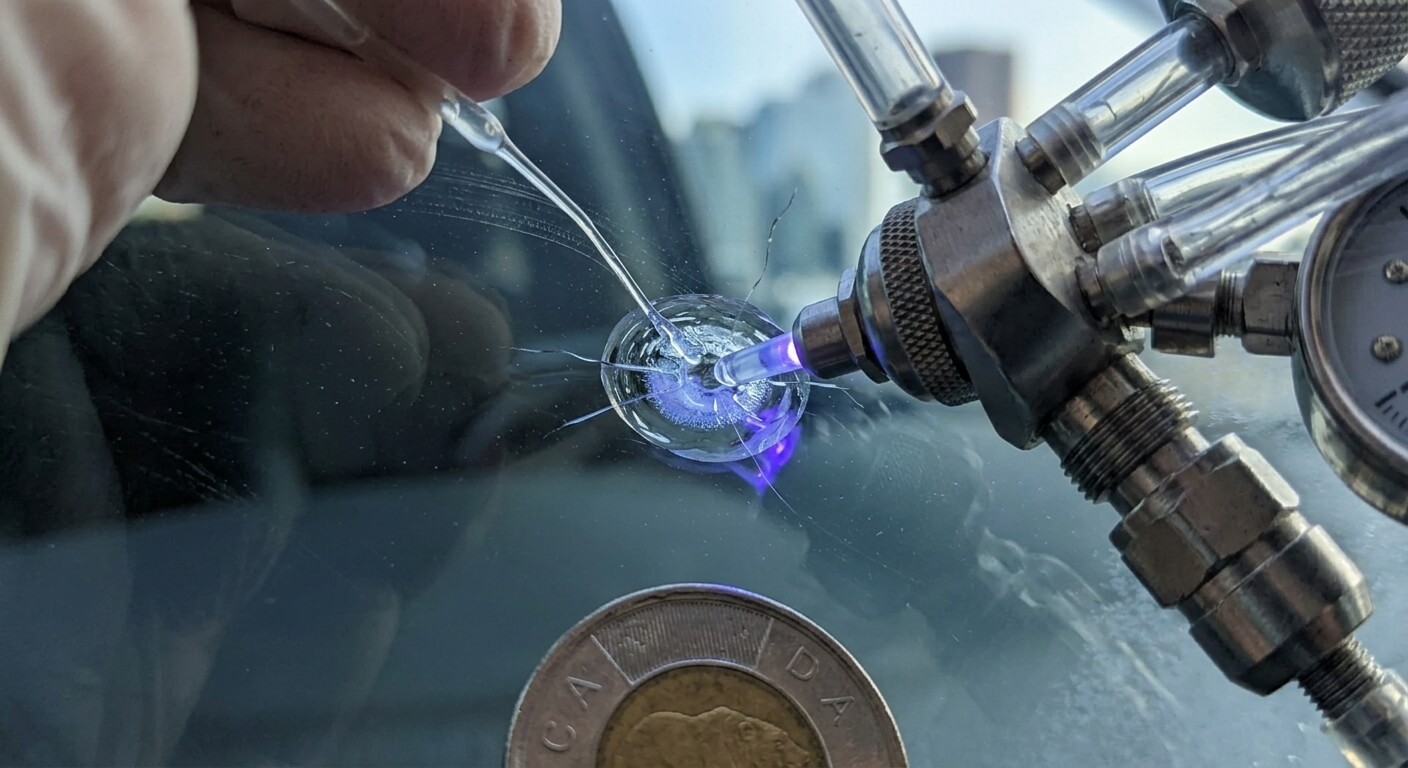
Yes most stone chips can be repaired, and the vast majority of windshield cracks in Toronto actually start out as a stone chip. A stone chip is repairable when it is smaller than a Canadian toonie in diameter, located outside the driver’s direct line of sight, and at least 4cm from the windshield edge. The repair process injects clear resin into the chip, sealing it and restoring the glass’s structural strength.
| Direct answer: |
| Can a stone chip in a windshield be repaired? Yes. Most stone chips can be repaired if they are smaller than a Canadian toonie (about 25mm), located outside the driver’s direct line of sight, and at least 4cm from the windshield edge. A technician injects clear optical resin into the chip under vacuum pressure, which seals the damage and stops it from spreading. Repair is most successful when performed within 24 to 48 hours of the impact, before moisture and dirt contaminate the chip. Most stone chip repairs take 30 to 45 minutes and are covered by Ontario comprehensive insurance with no deductible. |
2. Why stone chips happen the physics of impact
Understanding why a tiny stone causes windshield damage helps explain why size and speed are the two variables that matter most. Here’s the physics in plain terms:
- Speed multiplies force. A pebble that would do nothing if you threw it by hand becomes a high-energy projectile at highway speed. At 100 km/h, a small stone strikes with enough force to fracture the outer glass layer instantly. The relative speed between your vehicle and the stone (often kicked up by a vehicle moving in the opposite direction or perpendicular) can be even higher than your own speed alone.
- Your windshield is laminated, not solid. It’s built from two thin glass layers bonded with a polymer interlayer (PVB). This design is what prevents the glass from shattering completely the impact typically only damages the outer layer, leaving a contained chip rather than a full break.
- The impact creates a void, not just a mark. What looks like a small chip on the surface is actually a three-dimensional void inside the glass a cone or star-shaped cavity extending into the glass thickness. This void is what resin repair fills.
- Stress radiates outward from the impact point. The force of the stone doesn’t just damage the immediate area it creates stress lines radiating outward, which is why chips often have small hairline cracks extending from the central point even when the impact looks minor.

3. Why size matters the toonie rule explained
The most widely used standard in the Toronto auto glass industry is the toonie rule: if the chip is smaller in diameter than a Canadian two-dollar coin (about 25mm), it can almost always be repaired. Here’s why this specific size threshold exists:
| Chip size | Repair outlook | Why |
| Under 10mm (pinhead to pea size) | ✓ Excellent highest repair success rate | Resin fully fills the small void with minimal stress on surrounding glass |
| 10mm – 25mm (up to a toonie) | ✓ Good standard repairable range | Vacuum-pressure injection can still reach and fill the entire void effectively |
| 25mm – 50mm (toonie to golf ball) | ~ Borderline depends on shape and location | Resin may not fully stabilize the larger void; depends on chip type and technician assessment |
| Over 50mm or any spreading crack | ✗ Replacement likely required | Void too large for resin to restore structural integrity safely |
| Why the limit exists at all: Resin needs to flow into and completely fill the damaged void to restore strength. Beyond a certain size, the void is too large relative to the resin’s structural capacity air pockets or incomplete fills become more likely, and the repair may not hold under the temperature and vibration stress of regular driving. |
4. Why speed matters what happens hour by hour
Size determines whether a chip is theoretically repairable. Speed determines whether it stays that way. Here’s a realistic timeline of what happens to an untreated stone chip in Toronto conditions:
| Time since impact | What’s happening | Repair outlook |
| 0–24 hours | Chip is fresh and clean. Void is dry, no contamination yet. | Best possible outcome repair now |
| 24–72 hours | Dust, pollen, and road grime begin settling into the void. Driving vibration causes micro-spreading. | Still good repair strongly recommended |
| 3–7 days | Moisture penetrates the void during rain or car washes. Contamination reduces resin bonding quality. | Repairable but lower optical quality |
| 1–2 weeks (no temperature swing) | Continued contamination. Risk of spreading increases with each drive on rough roads. | Often still repairable book now |
| Any point + one cold night (below -5°C) | Trapped moisture freezes and expands inside the void, instantly extending the chip into a crack. | May no longer be repairable |
| 2+ weeks in active driving | Continuous vibration and temperature cycling has likely caused noticeable spreading. | Replacement often required |
| The single fastest way to lose repairability: water freezing inside the chip. Water expands by approximately 9% when it turns to ice. That expansion force is applied directly inside your windshield’s existing damage, and it doesn’t take much a single cold Toronto night below -5°C can turn a perfectly repairable 15mm chip into a crack that requires full replacement. This is the single biggest reason speed matters more than almost anything else. |
5. The 4 stone chip shapes and what each one means
Not all stone chips look the same. The shape tells a technician how the stone hit and how likely the chip is to spread. Here are the four shapes Toronto drivers see most:
| Shape | How it forms | Spread risk |
| Bullseye | A direct, perpendicular impact creates a clean circular cone-shaped void | Low most stable shape, easiest to repair completely |
| Half moon | Similar to bullseye but the stone hit at a slight angle, creating an incomplete circle | Low to moderate repairable using the same technique as bullseye |
| Star break | The stone hit at an angle with smaller cracks radiating outward in a star pattern | Moderate to high the radiating legs are weak points prone to spreading |
| Combination break | A complex mix of bullseye and star characteristics, often from a larger or irregular stone | High most difficult to repair completely; technician skill matters significantly here |
A star break specifically is the shape most likely to be caused by Toronto highway gravel the angled impact from debris kicked up by trucks tends to create radiating cracks rather than a clean bullseye. This is one reason star breaks are common but slightly more urgent to repair quickly than other chip types.
6. What to do in the first 10 minutes after a stone hits your windshield
Your actions in the moments right after impact genuinely affect the outcome. Here’s the correct sequence:
- Don’t touch the chip. Resist the urge to pick at it or clean it with your fingernail. This can introduce oils and contamination into the void.
- Avoid your windshield washer fluid on the chip for now. Cleaning fluid can seep into the void and interfere with the eventual resin bond.
- Cover it temporarily if rain is imminent. A small piece of clear tape over the chip can prevent rainwater from entering the void until you can get it repaired this is a temporary measure only, not a fix.
- Avoid extreme temperature changes. Don’t blast the defroster directly on a freshly chipped area, and avoid parking in direct hot sun if possible until repaired.
- Take a photo immediately. This documents the size and condition for your insurance claim and for the technician’s initial assessment over the phone.
- Call for a repair within 24 to 48 hours. This is the single most impactful action every hour that passes increases contamination risk and spread risk, especially in Toronto’s variable climate.
7. How stone chip repair actually works
Once you book a repair, here’s what a certified technician does the process directly addresses the physics described above by removing contamination and filling the void completely:
| Step | What happens |
| 1. Inspection | Technician measures the chip, identifies its shape (bullseye, star, half moon, combination), and confirms it meets the toonie rule and edge/sightline criteria. |
| 2. Cleaning | Any surface debris is removed from the chip using compressed air and cleaning solution critical if any time has passed since impact. |
| 3. Vacuum extraction | A sealed injector tool draws out air and any moisture that may have entered the void, creating a clean space for resin. |
| 4. Resin injection | Clear optical resin is injected under pressure, filling the entire void including any radiating cracks from a star or combination break. |
| 5. UV curing | Ultraviolet light hardens the resin, permanently bonding it with the surrounding glass and restoring structural strength. |
| 6. Polish and inspection | Surface resin is removed and the area polished, leaving the repair nearly invisible in most cases. |
The entire process takes 30 to 45 minutes and can be performed at your home, workplace, or anywhere across Toronto and the GTA. For a full breakdown of the process, see our step-by-step windshield repair guide.
8. Frequently asked questions
Can a stone chip in a windshield be repaired?
Yes. Most stone chips can be repaired if they are smaller than a Canadian toonie (about 25mm), located outside the driver’s direct line of sight, and at least 4cm from the windshield edge. A technician injects clear optical resin into the chip under vacuum pressure, sealing the damage and restoring structural strength. Repair is most successful when performed within 24 to 48 hours of impact.
How quickly does a stone chip spread in Toronto?
It varies, but Toronto’s climate accelerates spreading significantly. A fresh chip stays stable for the first 24 to 72 hours in mild weather. However, a single night below -5°C can cause trapped moisture inside the chip to freeze and expand, instantly extending it into an unrepairable crack. Heavy highway vibration and repeated temperature swings also accelerate spreading over 1 to 2 weeks.
What size stone chip is too big to repair?
As a general rule, chips larger than a Canadian toonie (about 25mm in diameter) are unlikely to be fully repairable. Chips between 25mm and 50mm are borderline and depend on shape and location. Anything over 50mm, or any spreading crack, typically requires full windshield replacement rather than repair.
Does the shape of a stone chip affect whether it can be repaired?
Yes. Bullseye and half-moon chips are the easiest and most reliable to repair due to their clean, contained shape. Star breaks and combination breaks have radiating cracks that are more prone to spreading and slightly more difficult to repair completely, though they remain repairable in most cases when caught early and within the toonie size limit.
Is stone chip repair covered by insurance in Ontario?
Yes. Most comprehensive auto insurance policies in Ontario cover stone chip repair with no deductible, meaning you pay $0 out of pocket. Insurers encourage early repair because it’s significantly cheaper than the replacement claims it prevents. Wind Auto Glass works directly with all major Ontario insurers and handles the claims paperwork on your behalf.
How long does stone chip repair take?
Most stone chip repairs take 30 to 45 minutes from start to finish, performed at your location anywhere in Toronto and the GTA. You can drive immediately after the UV-cured resin hardens there is no wait time, unlike a full windshield replacement.
Should I cover a stone chip with tape while waiting for repair?
A small piece of clear tape over the chip can help prevent rainwater from entering the void if you can’t get it repaired immediately. This is a temporary measure only and does not replace professional repair. The sooner you book a repair after the impact, the better the outcome ideally within 24 to 48 hours.