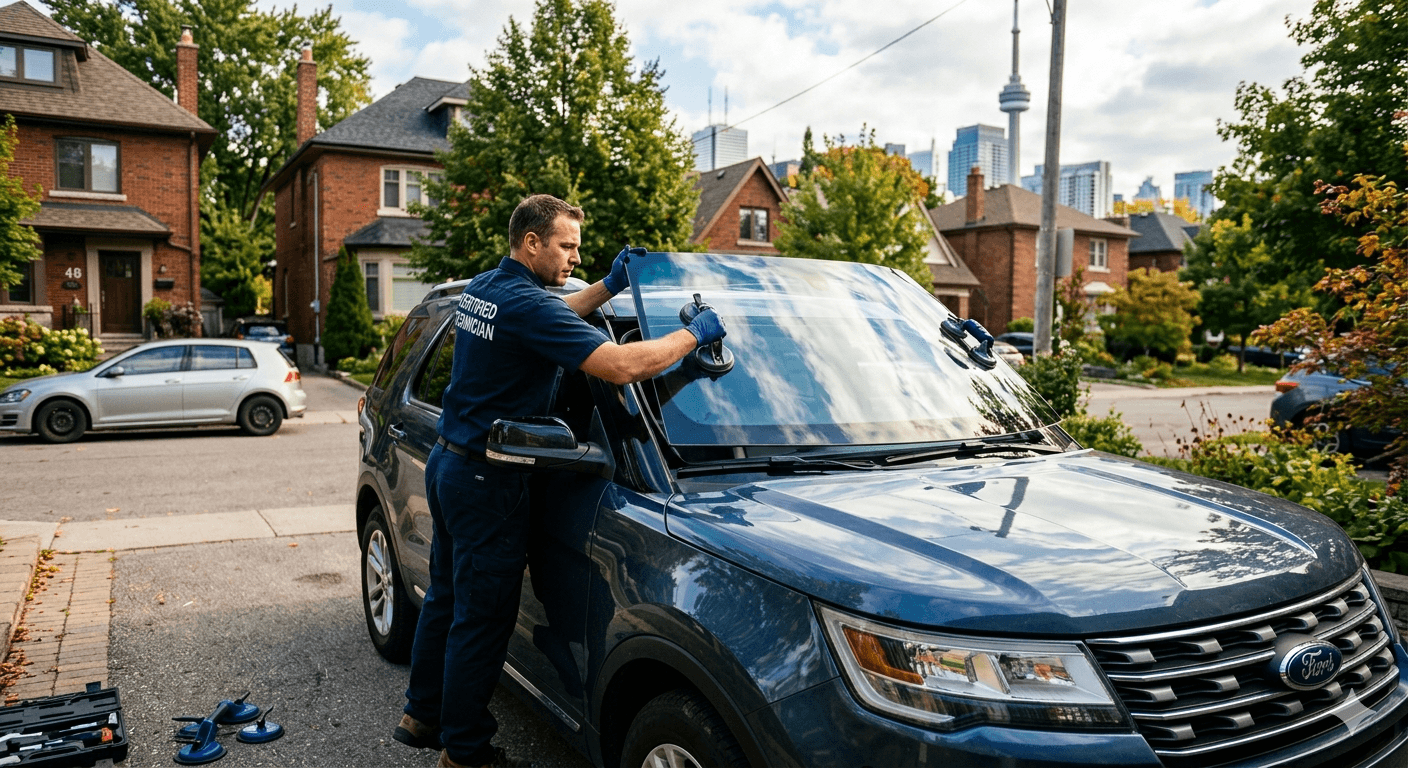
Sometimes a chip becomes a crack. Sometimes a crack becomes something that runs halfway across the glass. Sometimes a stone hits at exactly the wrong angle and the damage is simply too large, too close to the edge, or right in your line of sight. When that happens, repair is no longer the right answer — and replacement is. This guide is for Toronto drivers who are at that point. We’ll tell you exactly when replacement is necessary, what the process involves, what it costs, how insurance covers it, and what happens with your vehicle’s safety systems after a new windshield goes in.
1. When should you replace vs repair a windshield?
Replace when repair cannot safely restore the windshield’s structural integrity. Repair when it can. The decision comes down to five factors: size, location, depth, edge proximity, and the number of impact points.
| Factor | Repair | Replace |
| Chip size | Smaller than a toonie (25mm) | Larger than a toonie |
| Crack length | Under 3 inches | Over 3 inches — or over 6 inches even for specialists |
| Location | Outside driver’s direct line of sight | In driver’s direct line of sight |
| Edge proximity | 2+ inches from windshield edge | Within 2 inches of edge |
| Glass depth | Outer layer only | Inner PVB laminate layer penetrated |
| Number of chips | 1 to 3 individual chips | Multiple cracks or spreading combination damage |
| Previous repairs | No prior repairs in same area | Previously repaired area has failed |
2. The 5 situations that always require replacement
While the table above covers the full spectrum, five specific situations always require full windshield replacement — no exceptions:
| 1. Edge crack. Any crack that starts or ends within 2 inches of the windshield frame. The frame puts constant mechanical pressure on the glass — no resin repair can hold against that force. Edge cracks always spread, always require replacement. |
| 2. Crack in driver’s line of sight. Even a repaired crack in the driver’s direct sightline can create optical distortion. This is a safety issue and a legal one — a damaged windshield that impairs vision is an offence under Ontario’s Highway Traffic Act. |
| 3. Inner laminate layer penetrated. Your windshield has two glass layers bonded by a PVB polymer interlayer. If impact penetrates through to that inner layer, resin cannot restore structural integrity. This is the glass equivalent of a structural failure. |
| 4. Crack longer than 6 inches. Even highly skilled technicians with specialist equipment cannot reliably repair cracks over 6 inches. The resin cannot bridge the full length without leaving voids that weaken over time. |
| 5. Multiple cracks or combination damage. Three or more separate impact points, or a combination break where cracks have spread into a complex pattern across the glass, compromises the windshield beyond what resin repair can restore. |
3. How windshield replacement works — step by step
Windshield replacement is a precise process that takes 60 to 90 minutes when performed by a certified technician. Here’s exactly what happens:
| Step | What happens | Time |
| 1. Vehicle preparation | Interior and dashboard protected with covers. Wipers and trim pieces carefully removed and set aside. Surrounding seal and frame inspected for rust or damage. | ~10 min |
| 2. Old windshield removal | The existing glass is carefully cut out using a cold knife or power tool along the urethane adhesive bead. Glass removed in one piece where possible to prevent interior contamination. | ~15 min |
| 3. Frame cleaning and priming | Old adhesive residue cleaned from frame. Any rust or corrosion treated. Frame primed with bonding primer to ensure maximum adhesive adhesion for the new glass. | ~10 min |
| 4. New glass preparation | New OEM or OEE windshield inspected and prepared. Primer applied to glass edges. Fresh urethane adhesive bead applied to frame in a continuous, consistent line. | ~10 min |
| 5. Windshield installation | New glass lowered into position and pressed firmly against the adhesive bead. Alignment checked against all frame edges. Retention tape applied to hold glass during initial cure. | ~10 min |
| 6. Seals and trim reinstalled | Windshield seals seated around the full perimeter. Trim pieces and wipers reinstalled. All seals checked for gaps that could cause water leaks or wind noise. | ~10 min |
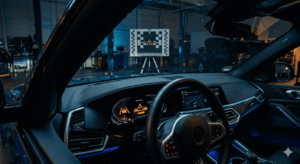
| 7. ADAS calibration (if required) | Camera and sensor recalibration performed using manufacturer-approved software for vehicles with advanced driver assistance systems. | ~60–90 min additional |
| Safe drive-away time: After replacement, you must wait for the urethane adhesive to cure before driving. Wind Auto Glass will give you a specific safe drive-away time on the day — typically a minimum of 1 hour, and up to several hours in cold Toronto winter conditions. Do not drive the vehicle before this time, and avoid car washes for 24 hours. |
4. OEM vs aftermarket glass — which should you choose?
When your windshield is replaced, you’ll be offered a choice of glass type. Here’s what the options actually mean:
| Glass Type | What it is | Best for |
| OEM (Original Equipment Manufacturer) | Glass made by the same manufacturer that supplied your vehicle’s original windshield. Identical in every specification — thickness, tint, curvature, and any embedded features (antennas, sensors, rain sensors). | Luxury vehicles, newer ADAS-equipped vehicles, drivers who want factory-identical replacement |
| OEE (Original Equipment Equivalent) | Glass made by approved manufacturers to the same safety specifications as OEM. Meets all Canadian safety standards. May differ slightly in brand markings. | Most standard vehicles — provides identical safety performance at lower cost |
| Aftermarket (non-certified) | Glass made without OEM or OEE certification. May not match exact specifications for thickness, tint, or curvature. | Not recommended — may not meet Canadian safety standards or ADAS calibration requirements |
Wind Auto Glass recommendation: We use OEM glass for luxury and ADAS-equipped vehicles where camera mounting positions and sensor integration depend on exact glass specifications. We use OEE glass for standard vehicles where it performs identically to OEM at a lower cost. We never use non-certified aftermarket glass. Learn more on our windshield replacement service page.
5. ADAS recalibration after windshield replacement
If your vehicle was manufactured after approximately 2016 and is equipped with Advanced Driver Assistance Systems (ADAS) — including lane departure warning, automatic emergency braking, adaptive cruise control, or automatic wipers — your windshield must be recalibrated after replacement.
Here’s why it matters: these systems rely on a camera and sensors mounted on or directly behind the windshield. When the windshield is replaced, even a fraction of a millimetre of positional shift in the glass can throw off the camera’s calibration angle. A misaligned lane departure warning might not trigger in time. An automatic emergency braking system might fail to detect an obstacle. These are not theoretical risks — they are documented real-world consequences of skipping ADAS recalibration.
| ADAS Feature | What it does | Recalibration required after replacement? |
| Lane Departure Warning | Monitors lane markings and alerts driver if vehicle drifts | Yes |
| Automatic Emergency Braking | Detects forward obstacles and applies brakes automatically | Yes |
| Adaptive Cruise Control | Maintains following distance from vehicle ahead | Yes |
| Automatic Wipers | Detects rain on the windshield and activates wipers | Yes |
| Forward Collision Alert | Warns driver of impending frontal collision | Yes |
| Traffic Sign Recognition | Reads road signs and displays speed limits | Yes — on many vehicles |
Wind Auto Glass performs both static and dynamic ADAS calibration using manufacturer-approved software for all makes and models. ADAS recalibration is typically covered by insurance when performed as part of a covered windshield replacement claim. See our ADAS calibration page for full details.
6. How much does windshield replacement cost in Toronto?
Replacement cost in Toronto varies significantly based on vehicle make and model, glass type, and whether ADAS recalibration is required. Here are realistic 2026 price ranges:
| Vehicle Type | Replacement Cost (Out of Pocket) | With Insurance |
| Standard sedan or compact (Honda Civic, Toyota Corolla) | $250 – $400 | Deductible applies (typically $300–$500) |
| Midsize SUV or crossover (RAV4, CR-V, Rogue) | $300 – $500 | Deductible applies |
| Full-size truck (F-150, Ram 1500, Silverado) | $350 – $550 | Deductible applies |
| Luxury sedan (BMW 3 Series, Mercedes C-Class) | $500 – $900 | Deductible applies |
| Luxury SUV (Audi Q5, BMW X5, Lexus RX) | $600 – $1,100+ | Deductible applies |
| ADAS recalibration (added to any replacement) | $150 – $300 | Usually covered with replacement claim |
| Rear windshield replacement | $200 – $500 | Deductible applies |
| Insurance tip: If your deductible is $500 and replacement costs $350, it makes no financial sense to claim — you’d pay the full cost out of pocket either way. Wind Auto Glass will always walk you through this calculation honestly before recommending whether to claim. We never push unnecessary claims. |
7. Is windshield replacement covered by insurance in Ontario?
Yes — windshield replacement is covered under comprehensive auto insurance in Ontario. Your deductible applies, unlike chip repair which is typically covered with no deductible.
Here’s how the claim process works when Wind Auto Glass handles it for you:
| Step | What happens |
| 1. We verify your coverage | We contact your insurer before any work begins and confirm your coverage details, deductible amount, and whether ADAS recalibration is covered. |
| 2. We provide a quote | You receive a transparent quote showing full cost and what insurance will cover vs what your deductible is. |
| 3. You decide whether to claim | If your deductible exceeds the replacement cost, we advise you not to claim. Your choice — no pressure. |
| 4. We complete the replacement | Windshield replaced at your location, same day where possible. |
| 5. We file the claim | We submit all paperwork directly to your insurer. You sign one form. That’s your only task. |
We work directly with Intact, Aviva, TD Insurance, Desjardins, Economical, CAA, and all major Ontario insurers. Under Ontario Regulation 777/93, you have the legal right to choose Wind Auto Glass as your repair provider — your insurer cannot direct you to a specific shop. See our insurance claims page for full details.
8. What to do after your windshield is replaced
Your technician will give you specific after-care instructions on the day. Here are the standard guidelines for the first 24 hours after replacement:
- Wait for the safe drive-away time before moving the vehicle. Driving before the adhesive cures can shift the glass and break the seal — causing water leaks and wind noise that are difficult and expensive to fix.
- Leave the retention tape on for the first day. The strips of tape holding the windshield in place during initial cure should stay on for at least 24 hours. Do not remove them early.
- Avoid car washes for at least 24 hours. The pressurised water of a car wash can penetrate a not-yet-fully-cured seal around the windshield edges.
- Crack the window slightly if you must close doors firmly. For the first few hours, slamming a door creates an air pressure spike inside the car that can stress a newly bonded windshield. Leave a window slightly open to equalise pressure if needed.
- Avoid rough roads and potholes for the first few hours. Excessive vibration during the initial adhesive cure period can affect the quality of the bond.
- Check your ADAS is functioning correctly. If your vehicle has driver assistance features, verify they are behaving normally after recalibration — lane departure warning triggering correctly, wipers activating in rain, and so on.
| Lifetime warranty: Every windshield replacement by Wind Auto Glass comes with a lifetime warranty on workmanship — covering water leaks, wind noise, and glass defects for as long as you own the vehicle. If any issue arises, we return and fix it at no charge. |
9. Frequently asked questions
When should you replace vs repair a windshield?
Replace when damage is larger than a toonie, when a crack is longer than 3 inches, when damage is in the driver’s direct line of sight, when a crack starts or ends at the windshield edge, or when the inner glass layer is penetrated. Repair when damage is smaller than these thresholds and located outside the sightline. A reputable shop will always assess before recommending replacement — repair is faster, cheaper, and free with insurance for most Toronto drivers.
How long does windshield replacement take in Toronto?
Most windshield replacements take 60 to 90 minutes. Add 60 to 90 minutes if your vehicle requires ADAS recalibration. After replacement, you must wait for the adhesive to cure — typically a minimum of 1 hour — before driving. Wind Auto Glass provides same-day mobile replacement service across Toronto and the GTA, performing the work at your home, office, or any convenient location.
Can I drive immediately after windshield replacement?
No. You must wait for the urethane adhesive to cure before driving — typically a minimum of 1 hour, and longer in cold weather. Driving before the adhesive cures risks shifting the glass and breaking the seal, causing water leaks and wind noise. Your Wind Auto Glass technician will give you a specific safe drive-away time based on temperature and conditions on the day.
Does windshield replacement affect my car’s safety?
A properly performed replacement using OEM or OEE glass and correct adhesive maintains the full structural integrity of your vehicle’s safety system. Your windshield contributes approximately 45% of your vehicle’s structural strength in a rollover accident. A poorly installed windshield — wrong glass, incorrect adhesive, or inadequate cure time — significantly reduces this protection. Always use a certified technician with a lifetime workmanship warranty.
Do I need ADAS recalibration after my windshield is replaced?
Yes, if your vehicle has ADAS features such as lane departure warning, automatic emergency braking, adaptive cruise control, or automatic wipers. These systems rely on a windshield-mounted camera that requires recalibration whenever the glass is replaced. Wind Auto Glass performs static and dynamic ADAS calibration using manufacturer-approved software for all makes and models. Recalibration is typically covered by insurance when included in a replacement claim.
Is windshield replacement covered by insurance in Ontario?
Yes. Windshield replacement is covered under comprehensive auto insurance in Ontario, with your deductible applying. Ontario deductibles typically range from $300 to $500. If your replacement cost is lower than your deductible, it may not make sense to claim — Wind Auto Glass will advise you honestly before recommending a claim. We handle all insurance paperwork directly with your insurer.
How do I book a windshield replacement in Toronto?
Call Wind Auto Glass at (647) 345-5894 or use the online quote form at windautoglass.com/quote. We offer same-day mobile replacement across Toronto and the GTA — our certified technician comes to your home, office, or any convenient location. We verify your insurance, provide a transparent quote, and handle all paperwork.