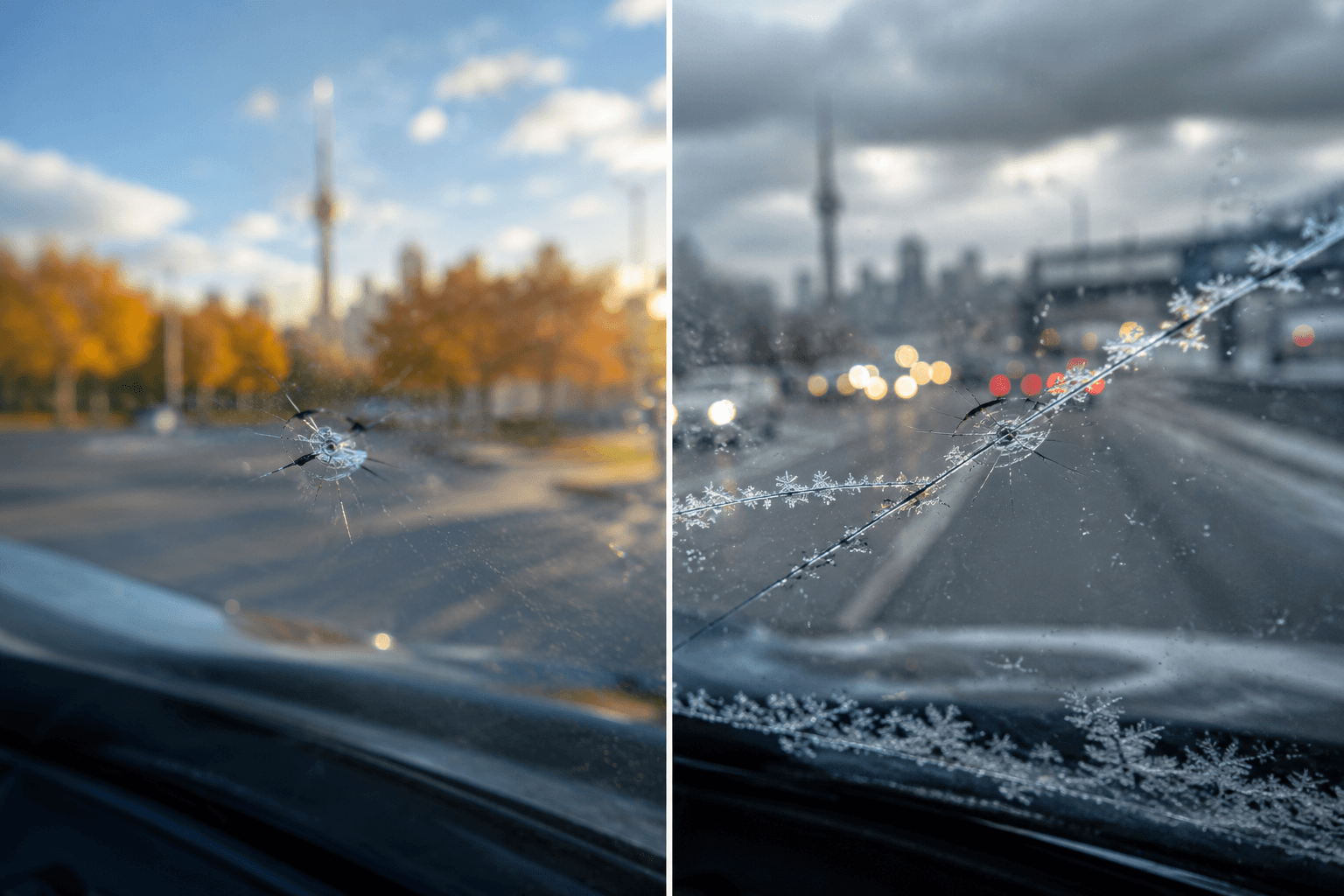
It happened so fast you almost missed it. A piece of gravel from the truck ahead on the 401. A small tap. Now there’s a chip the size of a five-cent coin sitting in the corner of your windshield. It doesn’t affect your vision. It’s not in your way. And life is busy — so you tell yourself you’ll deal with it later. Here’s the thing: that small chip has a plan of its own. And in Toronto, it works fast. This guide tells you everything you need to know about windshield chip repair — and exactly how long you can afford to wait.
1. How long can you drive with a chipped windshield?
The honest answer: as little as 24 to 48 hours in Toronto conditions. Technically, a small chip outside your line of sight won’t fail a roadside inspection immediately. But practically — especially in a city with temperature extremes, potholes, and constant highway vibration — a chip can turn into an irreparable crack within a single day.
The longer version depends on three things: where the chip is located, what the weather is doing, and how much highway driving you’re doing. A chip in the lower passenger corner on a mild spring day is lower risk than the same chip in February when overnight temperatures drop to -15°C.
| How long can you drive with a chipped windshield? You can drive with a small chipped windshield temporarily, but you should get it repaired within 24 to 48 hours. A chip that is outside your line of sight and smaller than a toonie is not immediately dangerous, but Toronto’s temperature swings, road vibration, and pothole impacts cause chips to spread into cracks rapidly — sometimes overnight. Once a chip spreads into a crack longer than 3 inches, it often cannot be repaired and requires full windshield replacement. |
2. What exactly is a windshield chip?
A windshield chip is a small area of impact damage to the outer layer of your laminated glass windshield. Your windshield is made of two glass layers bonded together with a polymer interlayer — when a stone or piece of debris hits it at speed, it creates a void in the outer layer. Depending on the angle and force of impact, that void takes a specific shape. The most common types Toronto drivers get are:
| Chip Type | What It Looks Like | Repairable? |
| Bullseye | Circular crater with a dark centre — looks exactly like a bullseye target | ✓ Yes — easiest to repair |
| Star break | Cracks radiating from a centre point like a star — common from highway gravel | ✓ Yes — highly repairable |
| Half moon | Half-circle impact — less uniform than a bullseye but same repair process | ✓ Yes — repairable |
| Combination break | Mix of bullseye and star — multiple crack legs from a single impact | ~ Depends on spread |
| Pit | Very small surface chip with no radiating cracks — often from small sand particles | ✓ Easy to repair |
The toonie rule applies to all chip types: if the damage is smaller than a Canadian toonie (about 25mm across), it can almost always be repaired. Bigger than a toonie, or already spreading into a crack? Get it assessed immediately.

3. Why do chips spread faster in Toronto than almost anywhere else
Toronto drivers face a particularly aggressive combination of factors that accelerate chip spreading. Understanding why helps explain the urgency:
- Freeze-thaw cycle. Water enters the chip void and freezes overnight. Water expands by roughly 9% when it freezes — that expansion force is applied directly inside your windshield chip, pushing the glass apart. A mild chip on Monday can become a 4-inch crack by Wednesday morning after two cold nights.
- Highway vibration. The 401, DVP, Gardiner Expressway, and 400 are among the busiest and roughest highways in North America. Constant high-speed vibration puts rhythmic stress on any existing chip, gradually propagating cracks outward.
- Pothole impacts. Every time your wheels drop into a pothole, a shockwave travels through your vehicle’s frame and into the windshield. That impact concentrates at the weakest point — your chip.
- Construction debris. Toronto is one of the most construction-active cities in North America. Fresh aggregate, gravel, and debris from active sites along Eglinton, the waterfront, and major condo corridors hit windshields daily.
- Temperature differential. Blasting your defroster on a cold windshield creates an instant temperature difference between the inside and outside glass surfaces. That thermal shock is one of the fastest ways to turn a chip into a crack.
| The worst combination: A chip picked up on the 401 on a Thursday in late October. Temperature drops to -8°C overnight. You blast the defroster on Friday morning. By the time you get to work, what was a repairable chip is a full crack across the driver’s field of vision. This is not a rare scenario for Toronto drivers — it happens every single week. |
4. Can every chip be repaired?
Most chips can be repaired — but there are limits. Here’s what determines whether your chip qualifies:
| Factor | Repairable | Not Repairable |
| Size | Smaller than a toonie (25mm) | Larger than a toonie with spreading cracks |
| Location on glass | Outside driver’s direct line of sight | In driver’s direct sightline — causes distortion after repair |
| Edge distance | More than 2 inches from glass edge | Within 2 inches of edge — frame pressure causes rapid spreading |
| Depth | Outer glass layer only | Penetrates inner laminate layer |
| Contamination | Fresh damage, clean void | Dirt and moisture deeply embedded — resin won’t bond properly |
| Age of damage | Repaired within 48–72 hours | Left untreated for weeks — contamination usually prevents clean repair |
| ✓ When in doubt, get it assessed: A free on-site assessment from Wind Auto Glass takes 5 minutes. We’ll tell you honestly whether your chip can be repaired or whether replacement is the safer call. There’s no obligation and no pressure. |
5. How windshield chip repair works
Chip repair is fast, clean, and done at your location. The entire process takes 30 to 45 minutes for a single chip. Here’s what happens:
| Step | What happens | Time |
| 1. Inspection | Technician assesses chip size, type, depth, and location. Confirms repair is viable. | ~5 min |
| 2. Cleaning | Area around chip is cleaned to remove dirt, moisture, and debris. Critical for resin bonding. | ~5 min |
| 3. Vacuum pressure | A vacuum tool is sealed over the chip to extract any remaining air and moisture from the void. | ~5 min |
| 4. Resin injection | Clear optical resin is injected into the chip under controlled pressure, filling the entire void. | ~10 min |
| 5. UV curing | Resin is cured with an ultraviolet light, hardening it and bonding it permanently with the glass. | ~10 min |
| 6. Polish | Surface is polished smooth. Chip is sealed, glass strength restored, spreading stopped. | ~5 min |
After repair, you can drive immediately. The UV-cured resin is fully hardened by the time our technician packs up. The repaired area will be nearly invisible — in most cases you’ll struggle to find it. And the chip cannot spread further because the void that allowed spreading no longer exists.
6. How much does windshield chip repair cost in Toronto?
Here are current price ranges for chip repair in Toronto as of 2026:
| Service | Out of Pocket | With Insurance |
| Single chip (bullseye, star break, pit) | $60 – $100 | $0 — fully covered, no deductible |
| Second chip (same appointment) | $30 – $50 additional | $0 — still covered |
| Third chip (same appointment) | $20 – $40 additional | $0 — still covered |
| Combination break (complex chip) | $80 – $120 | $0 — fully covered |
| Full replacement (if chip not repairable) | $250 – $600+ | Deductible applies |
The most important cost fact: the difference between a $0 chip repair today and a $400–$600 deductible replacement next month is usually just 48 hours. Chip repair is free with most Ontario comprehensive insurance policies. Replacement requires paying your deductible. Act now and it costs you nothing.

7. Is windshield chip repair covered by insurance in Ontario?
Yes — and this is the most important thing Toronto drivers don’t know. Under most comprehensive auto insurance policies in Ontario, windshield chip repair is covered with zero deductible. You pay nothing.
Insurance companies encourage chip repairs precisely because they’re cheap compared to the replacement claims they prevent. A $80 chip repair today eliminates the possibility of a $500 replacement claim next month. They’d rather pay $80 now.
We work directly with all major Ontario insurers — Intact, Aviva, TD Insurance, Desjardins, Economical, and CAA. We file the claim for you. You sign one form. That’s it. See our insurance claims page for full details.
| Under Ontario Regulation 777/93: you have the legal right to choose your own auto glass repair shop, regardless of what your insurance company suggests. You are free to choose Wind Auto Glass — and we’ll handle everything with your insurer on your behalf. |
9. Frequently asked questions
How long can you drive with a chipped windshield?
You can drive with a small chip temporarily, but you should get it repaired within 24 to 48 hours. A chip outside your line of sight and smaller than a toonie is not immediately dangerous, but Toronto’s temperature swings, highway vibration, and pothole impacts cause chips to spread into unrepairable cracks rapidly — sometimes overnight in winter. The sooner you repair it, the more likely it qualifies for free insurance coverage with no deductible.
How long does windshield chip repair take?
Most single chip repairs take 30 to 45 minutes from start to finish. Each additional chip takes roughly 15 minutes extra. The process — inspection, cleaning, vacuum, resin injection, UV cure, and polish — is done entirely at your location. You can drive immediately after the repair is complete.
Will the chip be completely invisible after repair?
In most cases, the repaired area is nearly invisible under normal lighting conditions. Some repairs leave a very faint mark at the impact point that may be visible under direct sunlight or a specific angle — but this does not affect visibility, safety, or structural integrity. The repair restores 80 to 95 percent optical clarity to the damaged area.
Is it worth repairing a chip or should I just replace the windshield?
Always repair if the chip qualifies — it’s faster, cheaper, and free with insurance. Replacing a windshield takes 60 to 90 minutes, costs $250 to $600+, and requires paying your deductible. A chip repair takes 30 to 45 minutes, costs $0 with insurance, and you drive away immediately. The only reason to replace is if the chip is too large, too close to the edge, or already spread into an unrepairable crack.
Can I repair a chip myself with a DIY kit?
DIY chip repair kits are available, but professional repair produces significantly better results. DIY kits use lower-grade resin without vacuum pressure, which means air pockets remain in the repair — weakening the bond and leaving a more visible result. A professional repair uses vacuum injection, UV-grade optical resin, and UV curing equipment. For a repair that’s covered by insurance at $0 cost and done at your home in 30 minutes, professional service is always the better choice.
Do you offer same-day chip repair in Toronto?
Yes. Wind Auto Glass offers same-day mobile windshield chip repair across Toronto and the GTA. Our certified technicians come to your home, workplace, or any location at no extra charge. Call (647) 345-5894 or use our online quote form to book — same-day slots are often available.
What happens if I leave a chip too long?
The chip collects moisture and dirt, making clean resin bonding impossible. Temperature changes cause the chip to spread into a crack. Once a crack is longer than 3 inches or reaches the windshield edge, repair is no longer possible and full replacement is required — at significantly higher cost and with your deductible applying. In Toronto, a chip left through even one cold night can cross that line.